Key highlights from the safety studies
Comprehensive safety studies were structured around four key areas: feasibility, risks, consequences, and response (refer to Figure 1). Findings across all four areas confirmed that ship-to-ship ammonia transfer at anchorage can be both safe and practicable, provided that recommended safeguards and operational controls are implemented.
The safety studies provided quantitative insights into the operational limits and emergency preparedness for this trial, forming a reference for future pilots and commercial-scale operations.
To establish the allowable weather envelope for safe ammonia transfer operations for this trial, a mooring analysis was conducted, referencing prior LNG bunkering operations. This analysis, which evaluated 36 different sea states, concluded that safe operations are possible up to a maximum wind speed of 20 knots and a swell height of 0.3 metres. These conditions are well within the weather threshold required to prevent bridge wing collisions.
Computational Fluid Dynamics (CFD) plume dispersion modelling was conducted to evaluate potential ammonia release scenarios. A conservative approach was taken, simulating a release of 33 m³ ammonia, corresponding to four times the volume of the most credible worst-case scenario.
At a wind speed of 10 m/s, CFD results showed that a 33 m3 release on the deck of the ship would produce a plume of up to 40 metres tall, 60 metres wide and 750 metres long. Within the dedicated anchorage boundary of 1 NM (1,852 metres), such a release is unlikely to pose safety risks or operational disruption to vessels at adjacent anchorage points.
Hazard Identification (HAZID) and Hazard and Operability Study (HAZOP) highlighted 23 medium-level risks specific to the trial that were mitigated through the implementation of additional controls, like the use of Emergency Release Couplings (ERC), avoiding simultaneous operations (SIMOPS), and stationing a standby incident response vessel. These findings form a basis that future bunkering operations can adapt and build upon.
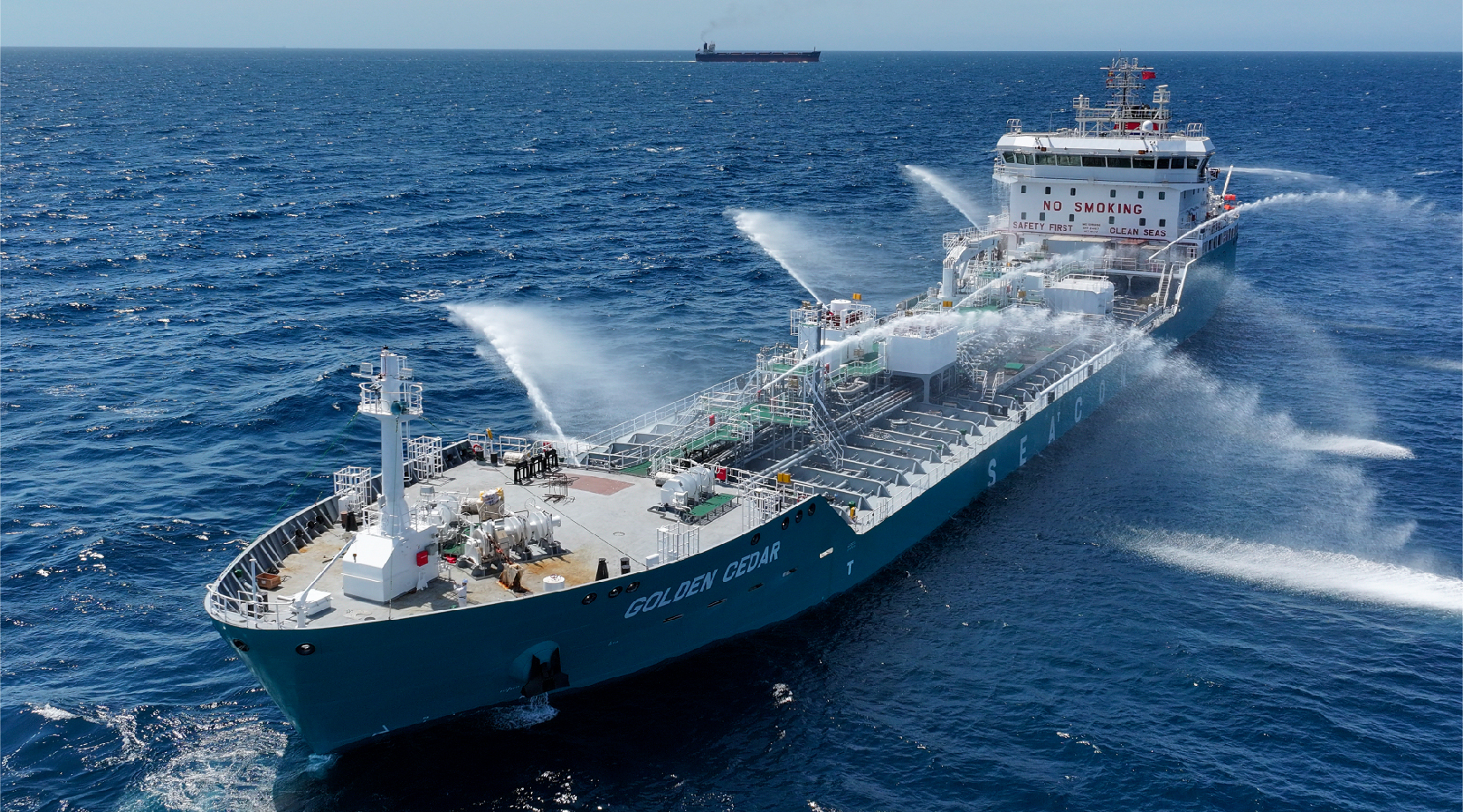
Emergency response measures included specification of communication protocols, a personal protective equipment (PPE) matrix, the appointment of an incident handler, verification of onboard spill kits, and the deployment of a firefighting tugboat. Vessel crews also conducted ammonia-specific emergency drills to reinforce readiness.
The report also documents the operational aspects of the trial, detailing the transfer systems, shutdown arrangements, and a timeline of key events.
Beyond the trial
The development of ammonia propulsion systems has accelerated, with the first twostroke dual-fuelled ammonia engine expected to be operational early next year. IMO’s approval of the world’s first global emissions pricing framework tied to GHG fuel intensities in April 2025 is likely to further position ammonia as a viable zerocarbon fuel for shipping. In light of these developments, GCMD is continuing its collaboration with industry partners to close safety, technical and operational gaps with real vessels and in front-running ports.